
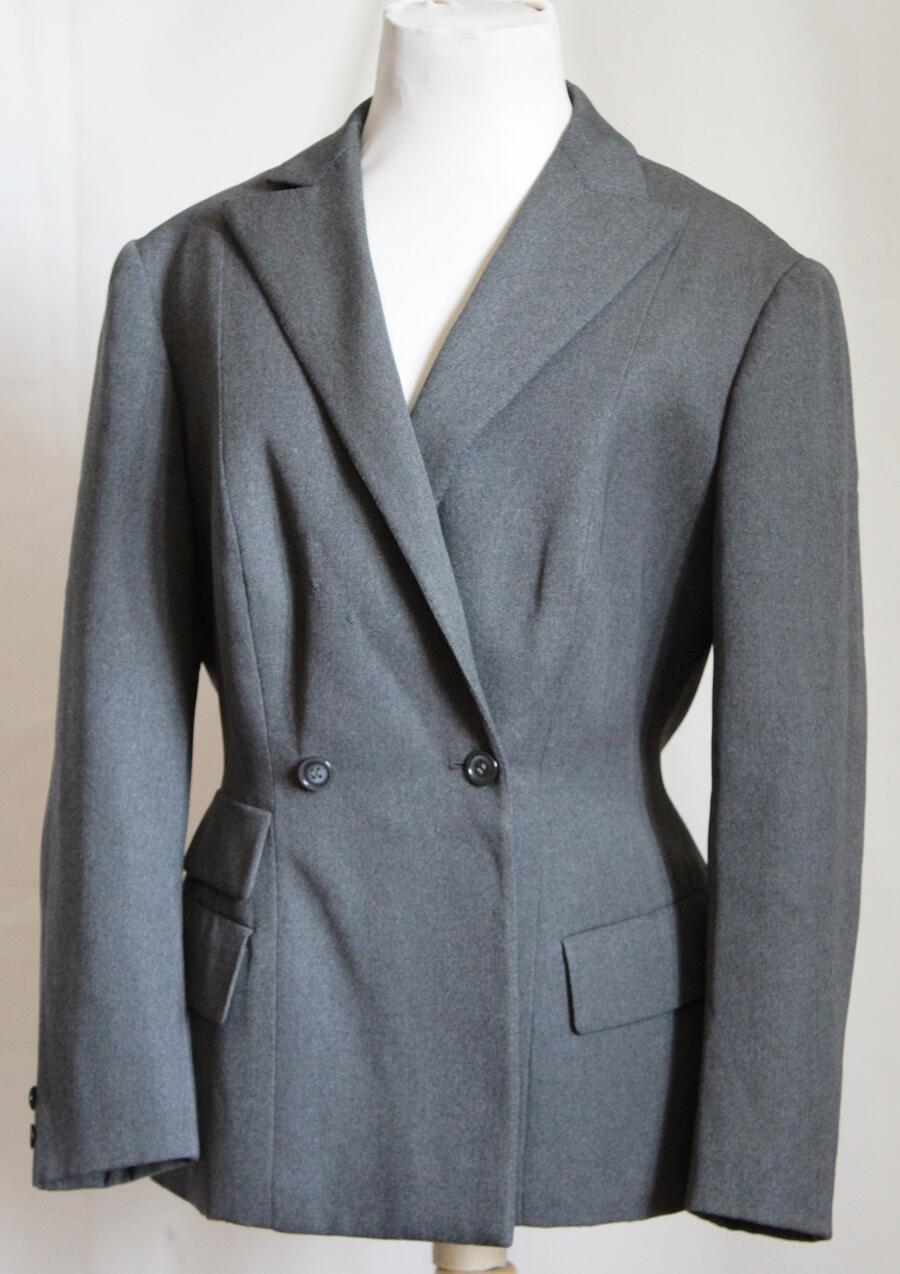
Women's jacket (part of the two piece skirt suit), according to the owner around 1960, and the owner of N.S.K. (collection MGZ, Zagreb)
Pictorial reflections of memorial fashion notes and artifact as a sign
Katarina Nina Simončić
Dress historians Ann Rosalind Jones and Peter Stallybrass approach the clothing artifact as a material witness in which the personal and social impulses of the atmosphere of the time are woven. Textile and clothing artifacts become stimulating objects of strong, melancholic memories, ie a memory record of everyday life from which one tries to analyze the body's attitude towards clothes, society's attitude towards clothes, with the usual basic analysis of stylistic and technical characteristics of the object.1 A. Rosalind Jones and P. Stallybrass called their methodological approach in the field of material culture in fashion material mnemonics,2 one of the most important reasons is that for a more effective understanding of clothing habits with archival data, they used images - portraits. In a similar way, in order to better understand historical and clothing artifacts, Lou Taylor and Peter Burke point to visual sources, graphics, images, and especially photographs as secondary but very useful witnesses.3 But for their adequate interpretation, they brought precise guidelines.4
In the documentary photo (MGZ, Zagreb) we find an item of clothing, a woman's ash-gray jacket owned by N.S.K. from Zagreb. Along with this jacket, the owner wore a skirt of the same material (which has not been preserved), straight cut below the knee length, which achieved a recognizable urban clothing code - a costume present in fashion since the late fifties and present until the seventies. The jacket is made of solid woolen fabric (material for men's suits). It is distinctly tailored, there are two seams on the front with eyelets, which contributes to the feminine silhouette. The lapel is deep with a pronounced fold, the fastening is two-row, with one button functional and the other aesthetic. Identical gray buttons are located at the end of each sleeve (two buttons). The asymmetrical arrangement of the pockets contributes to the dynamics of the front panel. Two pockets with a lid are located on the right below the waist height, while one is on the left. The described arrangement of the pockets was typical for a men's jacket, with the second pocket closer to the waist being called ticket pocket because it was used for a coin or tickets. However, the stylistic characteristics of the men's jacket can also be seen in the impression of the entire look, especially in the shoulder area. Probably the reason for this lies in the fact that the jacket is the work of men's tailors Braća Masnec (Masnec brothers), a salon that existed on Zrinjevac in Zagreb. Namely, if we look at the trends of fashionable women's jackets from 1959 to 1963, as promoted by the highly accepted women's magazine Svijet in Zagreb, we will notice that the shoulders are more rounded, that the sleeves and jackets are shorter… .and usually female tailored jackets have a single button fastening.
This deviation from the typically prescribed Parisian trends (Pierre Balmain, Lanvin Castillo) is proof of the personal stylistic affinity of the owner and the suggestions of tailors, which confirms the thesis of Jones and Stallybrass about clothing as a witness to woven not only social but also personal trends. There are also a few important points to consider about the atmosphere of time and space owned by N.S.K. belonged. Namely, after the Second World War, the new socio-political time encouraged women to be equal with men in building a socialist society, while time spent on looks and fashion was not considered socially useful.5 For this reason, a simple and functional style was nurtured in the civic culture of clothing, and a simple, comfortable, practical, elegant and occasionally modern silhouette was promoted (women's magazine Svijet from 1959 to 1965). Perhaps this is the reason for the assimilation of men's primarily functional clothing sensibilities, while potential Parisian women's trends have been partially ignored. Apart from the use of high-quality fabrics, the civic women's clothing was not completely without a handbag, gloves and heeled shoes (sometimes a hat).
We follow some of the listed fashion accessories (except hats) in a series of photographs at various locations in Zagreb, which take us for a walk with the owner of the jacket N.S.K., during a sunny autumn day in 1961 (October 22). Observing the shots taken by the photographer in the square of St. Marko, Strossmayer promenade, today's Ban Jelačić Square and Ilica street, we follow the smiling character N.S.K. in semi-furnished movements thanks to which we get a quality insight into the clothing composition, ie a civic clothing with fashion accessories, a handbag, gloves and shoes with a high heels (so-called stiletto). Unlike the garment analyzed above, the jacket in the photo is not identical. The buttoning is uniform, but it is as if the same woolen men's fabric was used and a similar distinctive tailoring. According to the owner, it was made by the same male tailor from the salon of the Masnec brothers. This series of photographs also testifies to the shapes and spaces of the presentation of clothing style, the way of wearing both clothes and fashion accessories (handbag, gloves, with or without a jacket, unbuttoned or buttoned) and their emphasis.


A series of photographs of N.S.K. on the streets of Zagreb, October 22, 1961, photographer unknown (private archives t.v.)
R. Barthes in his work Camera Lucida states that several imaginary records collide in portrait photography. Photography reflects what we think we are, what we would like to be, that is, how we would like others to see us, then how a photographer sees us and a record that reveals the layered charms of art.6 At the moment of photography, there is a transformation from the subject to the object, in which that moment freezes. It is for this reason that the characters we observe are no longer just what the photographer sees in them, but the new position of the object gives the photograph an expanded focus and makes it accessible to a more universal context. Photography gives us the opportunity to recall long-gone moments, turns characters into witnesses of clothing habits, while its study is an archaeological form of reading the fashion features of the time to which they belong. We observe a series of photographs from the personal archive of N.S.K.., dated in pencil on the back on October 22, 1961, as a visual memorial record of the presentation of Zagreb's bourgeois fashion and everyday life of the middle class. Through the eye of the photographer and the movements of the female character, through the memories of N.S.K. and studying the preserved garment, we analyzed the clothing features and adaptations to fashion trends based on the image - object - representation, characteristic of the sixties of the twentieth century.
NOTES
1 Rosalind Jones, Ann, Stallybrass, Peter (2000). Renaissance Clothing and the Materials of Memory. Cambridge: Cambridge University Press.
2 izv.: material mnemonics (Jones i Stallybrass, 2000:10). Mnemotehnika ili mnemonika je vještina povezivanja slika, riječi ili uspomena, u svrhu lakšeg pamćenja i rekonstrukcije određene pojave, u našem slučaju modnog fenomena.
3 Simončič, Katarina Nina (2018). „Uvod u povijest mode“. Teorija i kultura mode: discipline, pristupi, interpretacije, Paić, Žarko; Purgar, Krešimir (ur.). Zagreb: Sveučilište u Zagrebu Tekstilno tehnološki fakultet, str. 35-57.
4 Taylor, Lou (2002). The Study of Dress History. Manchester University Press; Burke, Peter (2003). Očevid. Upotreba slike kao povijesnog dokaza. Zagreb: Izdanja Antibarbarus
5 Simončič Katarina Nina (2019). „Modni dizajn i kriza“. Dizajn i Kriza, Design and crisis, Irfan Hošić (ur.), Buybook, 202-229
6 Barthes, R. (2003). Roland Barthes: Svijetla komora. Bilješka o fotografiji. Zagreb: Antibarbarus.
______
* The text was produced within the project Fashion: Object,Image, Text: relations of fashion garment, photographic image and reference text, 2021.
* The project was supported by the Ministry of Culture and Media of the Republic of Croatia, and the City Office for Culture of the City of Zagreb, for 2021.
* Photos: private srchives t.v.
* Copyright © cimo - Center for research of fashion and clothing. All rights reserved.
