
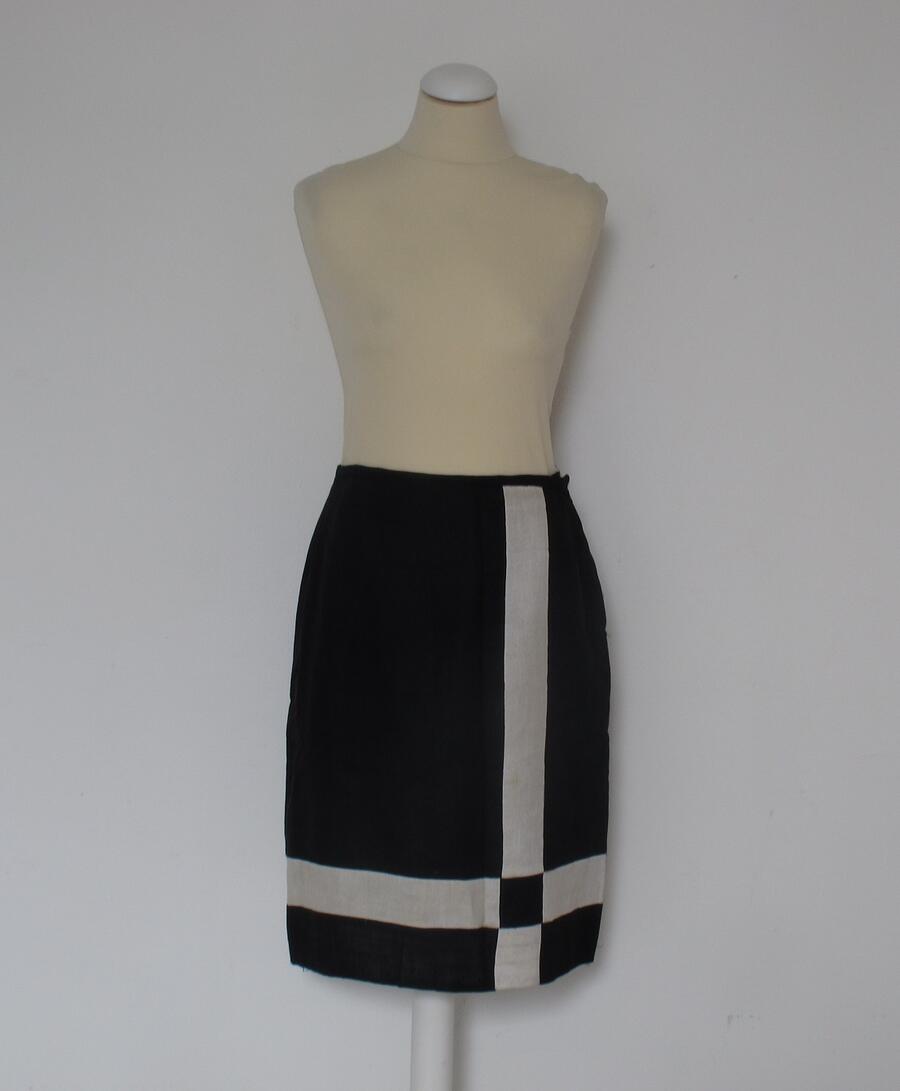
Fashion item: black and white skirt, Italy, around 1965, owner N .S.K., now owner Zagreb City Museum, Zagreb
Semantic context of the relation between object, image and text
Sonja Briski Uzelac
We are creatures of thought and conjecture. So we can do something that caveman couldn’t: develop a philosophy of culture. And culture appears to us in the form of an ever-growing collection of things ... (Vilém Flusser The Shape of Things: A Philosophy of Design)
Our eyes are given to see things, not to look at them. (Roger Fry, Vision and Design)
Problematization of the world of objects and their symbolic transformation between language and meaning, signs and symbolic modes, are among the basic concepts of the intellectual and practical horizon of modern times. They are the intonation according to which the whole modern view of the world is epistemologically adjusted, but also the basis of various practices of approaching how to create and "understand the world of desirable objects''1. 2021, the CIMO research team is launching a new project Fashion: Object,Image, Text: relations of fashion garment, photographic image and reference text, which discuss and theoretically and practically problematize these relationships within a certain fashion-clothing in historically defined space and time, thus opening a polyvalent and multifocal perspective of the hermeneutics of objects within the “language of things”.
Thus, as each age has its own "way of seeing" (J. Berger)2 a basic, independent and fruitful "generic idea", and not as a ready-made theory but as a tacitly fundamental way of seeing things, the language of naming or labeling is used to it would "shape the perception of how objects should be understood," which is "the key to understanding the man-made world.'' 3 Namely, this key is only a question of meaning, ie the semantic context of the object, because the object itself as a kind of (material) object does not exist without the notion of an object that has undergone (through verbal - word or visual - image) its symbolic transformation. In this sense, the "technique" of shaping or processing, the way we treat "given" objects, stems from these issues, from the way we see things, from the fruitful power of the conceptual scheme we apply and on which depends the abundance or scarcity of impressions and experiences about them. The semantic power of objects derives from the idea of meaning, and it is able to symbolize things, and not in their mere reality. The meanings of things are expressed in terms of relations to which the sign of a physical fact corresponds, but not only as a passive and mechanical echo of the empiricism of things, but in an analytically and syntactically constructive way. After all, our sense-data is already epistemologically present primarily as symbols, since the main factor in cognition is the use of symbols.
Examining the process of symbolic transformation is at the heart of those analytical approaches that start from the proposition of specifically human needs in which the "programmed plasticity of the brain"4 is the transformer of experience into symbolic creations. Symbolic transformation takes place not only in discursive thinking but in the whole human habitus, in various practical and expressive acts. In fact, on these different paths of symbolic transformation, thought itself emerges, as well as language and other forms of human social and individual consciousness (myth, ritual, religion, law, art). On each path of symbolic transformation, the transformation of experiential data into ideas, into various spiritual forms, into expressions, inventions, creations or the production of objects takes place. This insight owes the twentieth century to Ernst Cassirer5 and his definition of man as animal symbolicum, which speaks of the process of symbolization in which man's world of ideas and things emerges, which is then reflected in relevant phrases such as A.N. Whitehead's6 self-production, S. Langer's7 semantic context , and later the system of objects of J. Baudrillard, the fashion system of R. Barthes, the life of things of Deyan Sudjic. Symbolic reference as a transition from symbol to meaning precedes conceptual analysis as a mode that "objectifies" the life of current things under the linguistic sign (verbal, pictorial) of the presentation of immediacy.
Considerations about the transformation and symbolic transfer of experience are based on the understanding of meaning as a relation, and not as a quality of elements that are in a certain relationship. Thus meaning can be understood as a function of three elements: the one who means something, the one who is signified (object) and the one who uses them (subject); in addition, the sign represents the relation of these three elements, and the symbol also includes a concept (concept or idea or "logical image"). While a sign indicates, hints, or points to the present, future, or past existence of a thing and thus at the same time evokes an action corresponding to the presence of the object itself, symbols do not point to existing objects but represent a means of understanding objects; they, as an instrument of thought, directly "mean" some concept of things and not the thing itself. In the process of symbolization, progressive abstraction is active in which a concept is formed as a model, as what is common to all adequate conceptions of one or more objects, and it is what a symbol realistically utters or reflects. In this sense, the hiatus between perception and conception is abolished, and when the model appears in our imagination in this way, it turns into a personal conception and a particular sensory image in which the concept itself is located.
From this context, the notion of image in the sense of image, the formulation of experience as something imaginable, but also its construction as a media image (say, a photographic image) springs epistemologically. If the original function of symbols is the function of articulating experience, then the notion of image opens up a whole new world and gives, as Wittgenstein 8 would say, a "picture of the world" or a logical picture of some imaginary or real state of affairs. Hence the status of the image has the most pronounced symbolic character because it derives from the importance of imagination as a source of spontaneous (in terms of intuitive) mental (intellectual) activity; that is, it can be said that the original conception is imagination. As paradoxical as the term intuitive symbolism may sound, the process of symbolization is never as purely intuitive as it is purely discursive. Symbol in general, having connotation and denotation, implies the knowledge of a relational structure in which the concept appears as an image that has a common (real) form (configuration) with the symbolized object. In this sense, we can talk about the presentation function of (non) discursive symbols as a form of cognition which is the recognition of form as recognition of patterns, and which must pass through the individual imagination. In fact, one can speak of the relations of abstraction and the intensities of intuition, with the former being understood as an understanding of relational structure separate from things and the latter as a form not separate from things in which it is exemplified as object. The process of symbolization, therefore, implies meanings that are more or less direct, (un) expressive or communicative with regard to relational factors of abstraction and exemplification, but also the use of symbolic model (object, image, text), its presentative or representative functions.
It must be acknowledged that the power of symbolic expression and its semantic fertility that drives it is the most present and most referential in the verbal-textual symbolic mode, as the "most faithful image" of human experience, world, events and things in it. However, this does not mean that this semantic power that drives is not present in what cannot be projected in discursive form; on the contrary, the field of semantics is much broader than the field of verbal discursive language, as evidenced by the "language of things" as images of objects that are today more than ever part of the dominant visual culture. Discursive language has a strict, defined syntax; smaller and larger units of meaning that are successively and linearly connected within a certain, own system, building units of textual-reference meaning. Other languages (images, objects) also build meanings that are fully articulated, but in a different way. They also synthesize the whole by which meanings are understood, but in the general mode they are "untranslatable" or "unspeakable" because they present and simultaneously "self-expose" as signs and signifiers, appearing in chains of meaning systems, such as fashion and clothing. . They are understood according to the principle of universalium in re, at once, as that which is general in the individual thing, but also as diversity in unity (say, "style" or "zeitgeist").
We can also talk about the semantic mediation and power of "formulative" symbols possessed by some special objects, which can be explored multiperspectively in special case studies that connect many individually understood things or properties, and can distinguish elements from the originally created uniqueness of the whole. This confirms the view that sensory experience contains processes of formulating elementary abstractions that constitute and interpret the experience of the world, even when it comes to things that are difficult to say. It is in the combination of the fields of the utterable and the "inexpressible" that the conditions under which the original conceptual use of symbolism arises can be determined, and this is at the same time the conception of an object with all its semantic relations. It is a break with the world of mere signs and objects and is an entrance into the world of symbolic transformations that opens a new semantic starting point in the symbolic shaping and production of reality.
In the design and production of the reality itself, the images of that reality act by the force of their own appearances and events, and especially with the emergence of the industrial age, so do the images that are the product of that time. These are photographic images, "technical images" as free clusters of points of "informed objects", as Flusser 9 called them. They have been there for a long time, from the beginning of the industrial revolution until today, when they are already witnessing the transition from an economy based on the production of things to an economy based on the production of (non) material information in endless chains of signifiers. Thus, instead of linear thinking (coded in written text), visual, multidimensional thinking began to be established, which more directly symbolizes things by giving visible form to "formless chaos" (the world before our production-form action). Therefore, according to Flusser, things can be viewed in at least two ways: by reading and by observing. However, when objects are observed, they are seen as phenomena and are also read. They are not seen only as "neutral things" since each of them has a certain cultural / symbolic value because its semantic context offers an insight into the culture of a certain age, from everyday life to the interpretation of the universe. Therefore, design as a way of giving form to objects is spoken of as the "language of things" which recognizes the "vision of time". The very process of asking and resolving questions is as much an individual as a collective attempt at a fateful connection with a given space and time.

Model Nuša Marović in dress designed by Marica Krivić, photographer Mario Krivić, 1963.(private archive t.v.)
In this sense, all objects - clothing or laptop - are artifacts of equal importance, significance and ability to influence as actors of conceptual and creative action in the constantly open process of their heterogenesis. When found in a photographic image, the objectivity of the visual zone is symbolically constructed as a “character” captured by the lens, a fluid visual perception that crystallizes based on different light ratios and different levels of meaning. Namely, in photography, the figure of the "character" of the object is constructed as a form of dispositive that becomes a logical base, collection or archive of various "processes of construction of concepts, forms and meanings"10. At the same time, the photographic universe is increasingly proving to be a transition from textual to visual culture, creating a new, both mythical and discursive, relationship to reality. In any case, relying on the role of imagination, it is a matter of pictorial production of the world as fiction:
Images are surfaces of meaning that usually interpret something from space-time "out there" that he wants to present to us as abstractions (as abbreviations of the four dimensions of space-time to two dimensions of the surface). We will call this specific ability to abstract surfaces from space-time and re-project it into space-time "imagination". It is a prerequisite for creating and decoding images. In other words: the ability to encode and read into two-dimensional symbols and read those symbols.11
Each photographic image of an object carries its own story, which, of course, arose from the imaginative ability to create and decode images. However, the meaning of her universe is the resultant not only of the totality of combinations of her code but also of the intentions of the observer. Although the image can be encompassed by one view of the observer, his view is, on the one hand, directed by the structure of the image, and on the other, by his own intention (point) of observation. Thus, the images imply that they are “not‘ denotative ’(unambiguous) complexes of symbols (such as numbers), but‘ connotative ’(multi-valued) complexes of symbols that allow space for interpretation”.12 In fact, they are placed in that space, by the connotative power, between man and his reality, which they turn into a global scenography of images of "historical consciousness". The function of this so-called "historical consciousness" (ideology, fashion, etc.) is projected onto the world in a reference relation to images, but as their transcoding into conceptual systems denoted by text (linear sign), as a successive interpretation of circular notions or their notion direction. " Conceptual thinking in the text is a form of image metacode, their "logical-rational" recoding. But at the same time, it is a dialectical relationship of meaning exchange, when images, especially "technical images", become more conceptual and texts more intuitive and "imaginative", so that texts created as image metacodes themselves become image metacodes. This means that decoding the text, searching for its meaning, speaks of the process of discovering the images that the text signifies, which in turn further means that the rationalistically established hierarchy of the subject-image-text relationship is collapsing. This is a hierarchy of established codes, provided that the code means a properly arranged system of signs.
If we look at all the complex epistemological-semantic issues from the contemporary existential-practical point of view, we can emphasize and expand, or return to it, a concept that summarizes the various aspects of this very current issue. It is a term that we can describe with words the object of culture, that is, today we would say an informed object. At the core of this term is always a description of the situation as a scene / scenography in which the relationships between objects are important, and not themselves, as, for example, stated in the reference text:
Objects are the way we measure the transience of our lives. They are what we use to define ourselves, to signal who we are and who we are not. Sometimes that role is taken over by jewelry, sometimes the furniture we use in homes, or the personal items we carry with us, or the clothes we wear.13
In the abundance of these objects as cultural objects that are "intentionally placed" it is difficult to distinguish cultural conditions and their relations. The structure of cultural conditions eludes the very act of object perception, because it is always chosen by personal gesture in the "world of desirable objects". For that gesture, information is always reality, not just the meaning of that information. Therefore, the "language of things" is important because the condition of survival in a world covered with objects and their power of seduction through design in the function of the signal / sign / object / symbol / meaning chain. The origin of the aesthetic vocabulary is in the integrity and consistency of the whole conception of the object, its chain of signification; however, it also records traces of life as a vital force that gives "authority" to an object as an "object of desire", which is especially true of certain pieces of clothing. Pleasure refers to their purely physical, close presence, even a possessive connection that would reflect personal experience in relation to the passing of time. Thus arose and disappeared the aura of an object that would be supported by the language of design and its pictorial message or story, not so much depending on formal or functional problems as on interpretation, personal or collective. Some categories of objects, whether with minimalist or redundant visual language in design, which seek to be placed outside the system of fashion and transience, nevertheless always end up in the interpretation of space-time, own or subsequent. The designer has at his disposal means that deal with "the surface, appearance and semantic nuances of meaning, which allow us to interpret and understand what the object is trying to tell us about itself" and these messages range from what an object does, how much it is worth, to how to get involved. "14
In approaching objects, therefore, a system of language with a particularly strong visual reference is used to create a sense of identity - civic or national, collective or individual (for example, fashion) because it is a powerful means of interpreting both physical and material and social world. A famous statement from the editorial of Domus magazine from 1946 by architect Ernest N. Roger: "Study the spoon carefully and you will understand enough the society that created it to visualize how that society will design the city."15 Of course, in understanding the language of things there are constant doubts about whether it is a linguistic paradox between design and object or function and symbolism (shape, color, materiality, texture or photo-image of the object), because that language reflects the way the object made and the way it is symbolically constructed. Regardless of the purposes or different semantic contexts, it is technology that determines its general ultimate "character" reflecting the pre-industrial, industrial or post-industrial era. However, the imprint of technology is also a form of language and the emotional, rational or economic values adopted with it, a key that works powerfully while respecting the factors of the cultural context in order to reshape and understand the perception of the world. Within this field of view, the inevitable phenomenon of fashion acts as a "magic of code", "when reason falls under the impact of a mere change of signs"16, because when a sign signal becomes too obvious or ubiquitous, its meaning changes. Modernity, ie the evolution of production from craft to industry, co-opted the identity of culture into fashion, with the addition of the "intellectual aspect" in the aesthetic language of design or luxury moment, thus achieving the aura of a status symbol. However, the fashion scope from the broadest anthropological aspects to the garment reveals its range from the level of "original" (craft, art) to the level of banality (ready-made forcing), which becomes a pattern of all kinds of differentiation and endless semiosis of meaning.
As this phenomenon, as the driving force of industrialization (increasing production in innovative ways), has almost the entire reference reality behind it, media patterns have been devised to convey its prestige. Without looking for a functional alibi, such a pattern in the modern technological-information age imposed photography as a striking medium of the "objectively" visible signal of the representation of a fashion object and identification with it. It has also imposed itself with the meaning of the fashion paradox as a means of individual self-expression and at the same time a way of pre-prepared identity. It is this multiplicity (at least binary) that makes photo-messages a powerful force of inter-identity communication, its reference point, and therefore it is also a good archival tool of (post) historical research (say, the example of Western men's suits). Creating images of the identity of garments, showing their construction, palette of colors and materials, messages, and their accumulation and selection processes builds or changes the perception of gestures of existence and language of things, and ultimately worldviews. The medium of photography is otherwise marked by the phenomenon of change that accompanies and marks, from intellectual and social trends to constructive schemes of tailoring that drive the fashion system. If fashion can be said to be "the most developed form of planned obsolescence, the driving force of cultural change"17, then photography is the fastest form of visual record of these changes to which intentional and conceptual analyzes can be applied to indicate their emotional and cognitive capacity. Hence, therefore, in a whole range of cultural practices, "photography was central to changing the way we saw it, although it inherited rather than undermined the formal codes of the image."18
From the history of photography and from its four basic concepts - image, apparatus, program and information - it is quite clear "how existential interest from the real world passes to the universes of symbols and how the value of things passes to information."19 Photographs are such a ubiquitous universe that they began to mean the world as such, so their universe coincides with the outside world because they build his situations, so be they black and white. No matter how much we protested from the inside, gray is the color of theory, so a mixture of black and white world between the borderline cases of black (complete absence of all vibrations in the air) and white (complete presence of all vibration elements). It is clear that from the theoretical analysis of concepts the world cannot be re-synthesized, but it can be understood and interpreted from the process of coding / decoding the situation. It is about translating a concept into a concrete image, about discourses transcoded into symbolic situations, about deciphering an infinite number of levels in the sea of cultural consensus. Therefore, as a "beginning", a coding intention is needed, and "there is no end", ie it exists if it is conceptually established at the points of convergence as the interaction of intentions in photographing / informing and intention in translating / reading a photo image. Although photography as a medium of "technical image" seems to be a copy of three-dimensional situations from the external real world, as if it "reflected" itself on a two-dimensional surface, it is distributed as reproduction by any technical information, it is a link between objects, situations and information. It is thus accessible to all kinds of analysis and thus to semantic communication, as a dialogue or as a discourse about things and not the thing itself, while the function of the text is subject to the image.
NOTES
1 Subtitle of the book Sudjic, Deyan, 2008, The Language of Things. Understending the World of Desirable Objects, London: Penguin Books. / Dejan Suđic, [Jezik stvari. Kako razumeti svet poželjnih stvari], Beograd, Službeni glasnik, 2021.
2 Berger, John, Tne Ways of eeing, Penguin Books, London, 1972
3 Suđić / Suđic, p. 62
4 Malabou, Catherine. Malabou, Catherine / Katarina Malabu, 2018, ransformation of intelligence, What do we do with their blue brain, Belgrade and Zagreb: the Faculty of Media and Communications and the Multimedia Institute
5 Cassirer, Ernst, Die Philosophie der symbischen Formen, Bruno Cassirerm, Berlin, 1922, 1924, 1929,
6 Whitehead, N. Alfred, Symbolism: its Meaning and Effects, New York: TheMacmillan Co., New Yoirk, 1927.
7 Langer, K. Susanne, / Suzana Langer, Philosophy in a New Key. Study of the symbolism of reason, rituals and art, Beograd, Prosveta, 1967
8 Wittgenstein, Ludwig, Tractatus Logico-Philosophicus, K.Paul, Trench, Trubner & Co, London, 1972,.
9 Flusser, Vilém, Filozofija fotografije, Uvod. Zagreb: Naklada Scarabeus, Flusser, Vilém [ Philosophy of Photography] 2007. Flusser writes an extension of the idea of the technical image after this book (Für eine Philosophie der Fotografie, 1983. Berlin: European Photography); Flusser, William, 2011, Into the Universe of Technical Images, Minneapolis: University of Minnesota Press, (In 1963 he published his first book Língua e realidade / Language and Reality). As a philosopher and theorist of culture and media, Flusser was completely dedicated to the "phenomenology of things" and their language, so he also wrote about the "language of design".
10 Malabou, 2018. 9.
11 Flusser, Filozofija fotografije, 2007. Flusser, [Philosophy of Photography], 2007.p. 21
12 Flusser, ibid., 22.
13 Sudjic, 2021, 28. /Suđic, 2021.
14 Ibid., p. 41.
15 Ibid., p. 45
16 Beaudrillard, J, ''Is Fashion a Magic Code,” in. Moda: povijest, socilogija, teorija mode, [Fashion: History, sociology and theory of fashion], M. Cvitan-Černelić, Dj. Bartlett, A. T. Vladislavić (eds), Školska knjiga, Zagreb, 2002, p. 191-204.
17 Sudjic, D. (2021), Suđic, 2021. p. 187.
18 Wells, Liz / Vels Liz, (2006), Fotografija. Kritički uvod, [ Photography, A Critical Introduction], Clio, Beograd, p. 344.
19 Flusser, (2007), p. 119.
___________
* The text was produced within the project Fashion: Object,Image, Text: relations of fashion garment, photographic image and reference text, 2021.
* The project was supported by the Ministry of Culture and Media of the Republic of Croatia, the City Office for Culture of the City of Zagreb, for 2021.
* Photos: private archives t.v.
* Copyright © cimo - Center for research of fashion and clothing. All rights reserved.
