
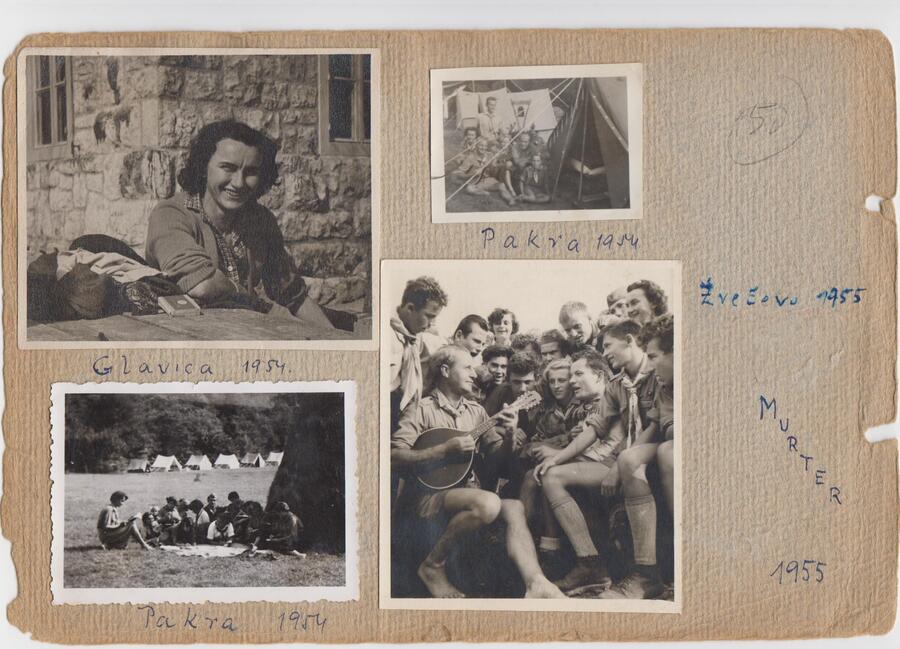
Free time in Pakrac, 1954
Towards the fashion archive - archive as a contemporary reinterpretation of the collection / museum
Sonja Briski Uzelac
The museum, as Donald Preziosi said, "is one of the brightest and most powerful genres of modern fiction, which shares with other forms of ideological practice (religion, science, entertainment, academic disciplines) different methods of producing and actualizing knowledge and its social and political consequences." As one of the first epistemological technologies of the Enlightenment, the museum emerged from the "collection of collections," and the pragmatic effect of the fusion of museums and collections is the modernist ideology of the role of representing "historical truths" through "evidence artifacts." As this role has constantly evolved in favor of the scenario of technologically neutral modernization and rationalization of "collecting activity", today, in the age of accelerating development of information communication media, museologically and archivally separated "warehouses of objects" become paradoxically more invisible, as fruits of historicism "buried" In this respect, the paradigm shift of the institution of archiving in the modern world, which replaces the disciplinary procedures of museography with electronic practice of new media in creating a database, expands the reference field of the new "archeology of knowledge" to unimagined communicative and informative possibilities. The strategy of organizing knowledge within conceptual consistencies, as well as the order and clarity of purpose, and the heterogeneity of spirit and uniqueness of the mission, create interactive passages in the space-time framework of determinism and causality. The virtual reality of the archive, with its abundance of visual positions and the wondrous diversity of human existence and expression, has a distinctively hybrid epistemological status in the new disciplinary space. While the institutional space of the museum puts us in the picture by teaching us how to fit perfectly into it, the paradigm of the electronic archive pushes formal, disciplinary, thematic, or worldview boundaries and is both referential and differential. In this sense, the archival view is simultaneous and successive, moving in both the foreground and the background, and always present in the interpretation. For users, an archive based on the benefits of interactive media is a readable field open, even though the view is dislocated; all objects, at any time and in any place, can be seen together in the same space of knowledge. The vision of this archive project is a formatted distribution of space of active social memory and not a system of representation.
* The text is part of the research work on the project: Family archive - the relationship between photography and memory, CIMO, 2015
* the project is supported by the Ministry of Culture of the Republic of Croatia and the City Office for Culture, Education and Sports of the City of Zagreb for 2015
* Copyright © cimo - a center for research of fashion and clothing. All rights reserved.
* Photos: private archives t.v.
