
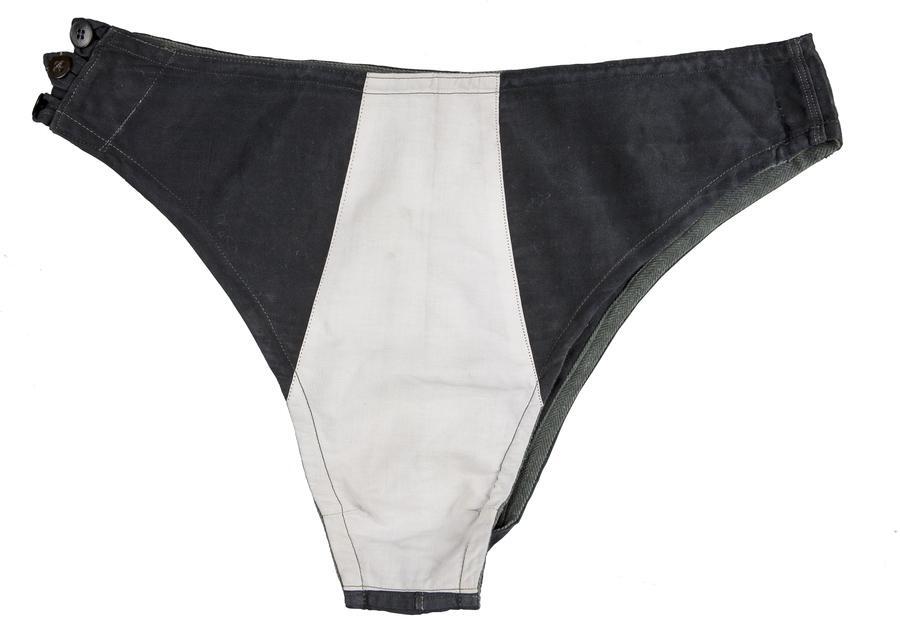
Hand-sewn men's swimming trunks with side fastening, between 1946 and 1950, fashion and clothing collection, MGZ, Zagreb (photo by MGZ, Zagreb)
An object on the way to image, language and fashion
Tonči Vladislavić
'' But photography, say, like a stethoscope membrane, is able to amplify every feeling I experienced the moment I was exposed. Because photography really can't do otherwise, it can't choose. and does not see into the future. As, of course, it does not see into the past. One image will ultimately be just the point at which the future touches the past for a moment. Or, if we prefer, where the present lasts indefinitely. Yes, this may be clearer. If anything can be said about photography at all, to be clear enough. "
Attila Bartis, Svršetak (The End), Fraktura, Zagreb, 2020.
No item is neutral, at least it can't stay that way, and neither can a garment. And before it becomes part of someone’s clothing range, instead of preserving the object’s neutrality, it is personalized.
The object itself is a material fact in a certain space and time. Although it belongs to the primary haptic experience that is realized only in touch, haptic also implies everything necessary for the object to arise and become part of material reality. Only when the subject is completed does it acquire the function that determines it, it becomes part of the space in which relationships are created and inscribed, individual as well as social, so the subject really ceases to be neutral.
We can say that the garment is anatomical (determined by a system of measures) but also physiological (monitors the organic processes and functions of the organism in standing and moving). When the body appropriates an item of clothing, a lasting history begins but also the semantic level of the item. Or, as Deyan Sudjic 1 says in the title of his book, The Language of Things, the subject develops its language by becoming part of a "system of objects" (J. Beaudrillard).2
There are many dimensions that will be inscribed in this subject by building a multi-layered and complex narrative. Today, industrial objects are the result of design thinking and work, which instead of the original creates an unlimited repetition of always the same object.
And what happens to items that are not a “model” but just a copy of the model as part of mass production? Here it is necessary to quote again Beaudrillard who in his text The System of Objects makes a clear distinction ''between the industrial model and the industrial object ", ie between something thought of as an" idea "and the series itself.
Dušan Pirjevec, in his text The Fate of Art in the Technical Age, states an interesting idea that "the mathematical description of an object is always a description of the principles of its production." (Pirjevec...)
The object thus represents an archive of materiality, form, construction and technology of production, as well as an imprint of the life of the object even before personalization.
Objectivity of the garment
Men's swimming trunks are part of the collection of (fashion) clothes of the Museum of the City of Zagreb, where they are in the part that belongs to the late 1940s, although they can be found as clothing in the 1950s and later. Such immutability of form and material is the result of production and market realities in this period. The item is made of glott3, which owes its name to German origin and denotes a smooth glossy black garment material used mainly in non-fashionable garments. It is a fabric, always 100% cotton, affordable, and still produced as a black material for pocket, with an assortment of cic - materials (which are mostly multicolored and colorful, small pattern), and are more used for basic clothing.
In the period of post-war deficient production of textile materials (in the period after 1945), it was universally present in individual, home sewing, from which various clothing items were made, such as men's swimming trunks, shorts, sports shorts, protective sleeves for workers in administrations as a kind of handcuffs that protected white shirts from dirt, but probably achieves its iconic status the most in making school protective cloths, and today it is retained in traditional clothing for aprons, skirts, blouses for older women as clothes for housewives and as a sign of widowhood status, predominantly among the rural population.
These swimwear, as well as other similar garments, are the result of home handmade , not industrial production. The life of this garment was almost subordinated to a new, freer way of life becoming evidence of a modernist lifestyle and a new fashion awareness. The development of a strong desire to fulfill free time, sports practices, new ways of using summer vacations, started the home production of fashion items, including men's swimming trunks. On the construction side, this triangular garment required a lot of knowledge and skills to produce, so there were handicrafts that did not always show a good knowledge of anatomical facts. The solution lay in a kind of coping, modeling an already existing garment in the form of added seams, and the size could be adjusted to the side, subsequently stitched folds. The size adjustment was most often located laterally at the fastening point by moving the fastening buttons or tightening the laces that passed through the sewn holes. One-sided side fastening, usually on the left side, also helped with changing clothes because pants could be pulled on, and then wet swimming trunks could be pulled out through one leg, which was often used as a wet headband and protection from high heat.
Very often the black monochromatic surface of black cotton bathing suits received a white sewn-on wide strip along the middle front part, also from "ordinary" bed canvas. This minimalist intervention means the fashion of the object, and from today's point of view it represents an aesthetic and fashion intervention that separates the object from the banal repertoire of poverty and mere resourcefulness.
Amateur photographic image
When we look at an amateur photograph bought at Zagreb Sunday's antiques fair on British Square, and on the back of which we find only the information recorded in pencil that it was taken in 1947, we are left to notice what it shows a younger man in a swimming trunks.But the photograph was not primarily intended to show an item of clothing but to record a much more complex story, ranging from the intention to keep the photograph a record for a lasting memory to a cultural fact.
Because as Annette Kuhn says, in Rememberance: The child I never was, 4
'' What I'm saying is: memories evoked by a photo do not simply spring out of the image itself, but are generated in an intertext of discourses that shift between past and present, spectator and image, and between all these and cultural contexts, historical moments. In all this, the image figures largely as a trace, a clue: necessary, but not sufficient, to the activity of meaning-makin; always signalling somewhere else. Cultural theory tells us there is little that is really personal or private about either family photographs or the memories they evoke: they can mean only cultural. ''
In the foreground, a man poses sitting on a protruding rock that encloses the lower part of the photograph as a dramatic staging of the coastal landscape. The man's body was thus given a solid pedestal which was used for a semi-sitting half-profile and the gaze was turned quite opposite to an imaginary point outside the image format. Photography is dominated by an almost naked, muscular body, in a position that wants to capture the ideal body. This pose, although not lens-oriented, wants to be a good motive for the photographer himself. In the middle is a large part of the sea belt and in the background is a landscape of exceptional beauty with a large antique hotel, villa, in the center of photography. By this we mean not only that the photos show that something was but also how it was, or could be. We cannot conclude from the photograph whether the protagonist is a guest of this particular hotel, ie an old villa, but it provides a framework that creates the illusion of social status. It should be emphasized here that this amateur photography, where the protagonist chose the place, the pose and the context itself, reveals his imaginary that needs to be immortalized. As we observe, because this is a spontaneous and "private" event and amateur photography, it is imposed that this imaginary desire created just such a photograph that has long been preserved in the family album and was certainly shown, or rather shown, as proof that it once was. Like where it was. But I keep watching trying to figure out what the photo wants to say. As Roland Barthes says, '' that certainty is superb because I have time to look closely at the photograph. However, no matter how much I prolong this observation, it tells me nothing. It is precisely in this stalemate of interpretation that the certainty of this Photography lies. I am exhausted to establish that it was; whoever For anyone holding a photo in their hand, it is a "fundamental belief."

Swimmer on the beach, 1947. Photographer unknown (private archive t.v.)
Author's photo: the path to language
Unlike amateur anonymous photography, we will look at a photograph of Milan Pavić from 1949, which is in the collection of recent photography at the Zagreb Museum of Arts and Crafts, and is presented in the catalog of Photography in Croatia,5 p. 371.
What makes this photo interesting for our case is the item of clothing, ie swimming trunks that records the model we are dealing with. Swimming trunks are also made of canvas, light in color, with all the characteristics of homework. Instead of button fastening, we notice double-sided binding, which better adapts the cut and the lack of stretchability of the material
This author's photograph is different in many ways: the whole frame is dominated by a figure of a younger man, a fisherman, slightly bent, making a strong diagonal of the image, which is opposed by a diagonal in the opposite direction in the form of an underwater fishing harpoon. The fisherman’s gaze is focused on the action of adjusting the harpoon in an attempt to master the spring which emphasizes his muscular body. In the lower foreground you can see part of the boat, and in the background a wooded landscape that occupies only half of the picture, and the upper half is filled with a little cloudy sky. The body fills almost the entire frame, contrary to the pronounced perspective that brings the fisherman here before us. The photographer subordinated the whole composition to the strength of the body at the moment of tense action.

Photo: Milan Pavić, Fisherman Štakula from Dubrovnik, 1949, MUO, Zagreb
In the face of amateur, anonymous photography on the one hand, and authorial photography on the other, it seems that the garment chooses different paths to speak about itself and only thus reveals its multi-layered meanings. It seems that, despite the transience, the object has an inscribed latent dimension, to live in very different ways: in different situations it reveals its potential aspects confirmed by a photographic lens. Each time we discover a new semantic layer determined by the situation and context. It is inevitable that we treat the subject as a reference object that seeks a constant chance to express its imaginary potential. Each time, the clothing item confirms with its representation that only when it realizes the imaginary reveals its placement in the language where in a specific visual text it reveals its intentions.
And this is every visual assembly where, instead of mere dressing, fashion begins, when the object has reached the language, or rather, when it is embodied in the field of culture through the "language of things".
NOTES
1 Sudjic, Deyan, The Language of Things, Penguin Books, London, 2009.
2 Baudrillard, J. ''The system of objects,'' in J. Thackara, (ed.), Design After Modernism: Beyond the Object, London, Thames and Hudson, 171.
3 https://www.enciklopedija.hr/natuknica.aspx?id=22367
4 Kuhn, A. (2003), '' Remembrance: The Child I Never Was, '' in Liz Wells (ed.), The Photography Reader, London and New York, Routledge, p. 397.
5 Maleković, V. ed. (1994), Photography in Croatia, 1848-1951, Museum of Arts and Crafts, Zagreb, 20.9.- 20.11.1994., Zagreb, MUO. p. 371.
LITERATURE
PIRJEVEC, Dušan, 1981: Sudbina umjetnosti u tehničko doba [The Fate of Art in the Technical Age] ,in Plastički znak [PlasticSign], ed. Nenad Miščević, Milan Zinaić, Izdavački centar Rijeka, Rijeka, 1981, p. 19.
BARTHES, Roland, Svijetla komora [ Camera lucida], Antibarbarus, Zagreb, 2003.
BAUDRILLARD, Jean, The system oif objects,, in. Design After Modernism, ed. John Thackara, Thames and Hudson, London, 1988., 171.
BAUDRILLARD, Jean, Sumrak znakova [Twilight of Signs ], ed. Ješa Denegri, Dizajn i kultura [Design and Culture], Radionica SIC, Beograd, 1985., p. 167.
________________
* Author of the photo: Milan Pavić, Ribolovac Štakula iz Dubrovnika [Fisherman Štakula from Dubrovnik], 1949, MUO, Zagreb.
We thank Ms. Slavka Pavić and MUO, Zagreb, for kindly granting the right to use copyright photography with this text.
* Other photos: MGZ and Private archives t.v.
* The text was produced within the project Fashion: Object,Image, Text: relations of fashion garment, photographic image and reference text, 2021.
* The project was supported by the Ministry of Culture and Media of the Republic of Croatia, the City Office for Culture of the City of Zagreb for 2021.
* Copyright © cimo - Center for research of fashion and clothing. All rights reserved.
