
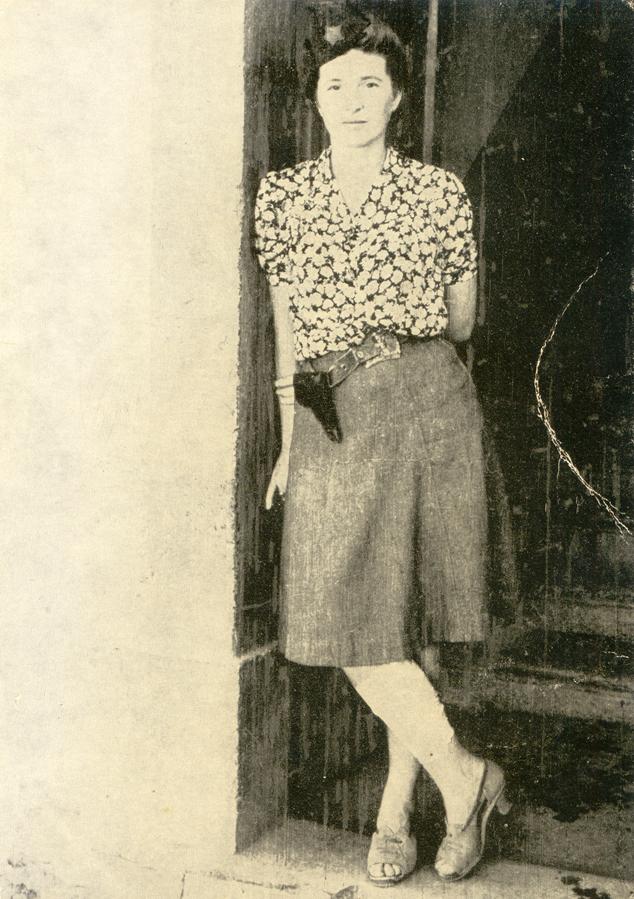
Partisan, photographer unknown, Crikvenica, 1945.
Exhibition Comradess à la mode: clothing and fashion in Zagreb from 1945 to 1960, Zagreb, MSU, Pavilion 19., Zagreb Fair, 27.04. - 14.05.2006
Exhibition Comradess à la mode: clothing and fashion in Zagreb from 1945 to 1960, Belgrade, MIJ - Museum of the History of Yugoslavia., 16.07. - 02.10.2011.
..
The exhibition Comradess à la mode: clothing and fashion in Zagreb from 1945 to 1960. follows the phenomenon of clothing and fashion in Zagreb from 1945 to 1960.
This period, seen from the perspective of the culture of dress and the development of fashion discourse, is especially interesting in this area, since there are the effects of the imposed ideological matrix characteristic of Yugoslav socialism in the stereotype of ''comradess", with preserved memory of the stereotype of "lady." Fashion discourse will be marked by the presence of the ambivalence of the propagated ideological type of non-fashion comradess and the desire for the lady’s fashion. In this conflict, a specific view of clothing and fashion will be gradually established, so it can be said that Zagreb is an example of a quick acceptance of fashion challenges, despite the ideological rigidity of the politically tailored reality.
We can follow the development of clothing and fashion in accordance with the development of social reality, which is determined by several key historical facts:
The first post-war period is an ideological imposition of manifest socialist realism, which determined life in this area until 1948, when Tito rejected the political dictates of the Soviet Union (Stanko Lasić considers this period a period of "violent ideologisation of all life").
The period from 1948 to 1952 follows (this is the time of gathering of members of EXAT 51, which Lasić considers a “transitional period”).
The period from 1952 speaks of a "more open and conciliatory atmosphere" (Ješa Denegri). The period of EXAT 51 (1951 - 1956) will mark “a short, but turbulent, precisely the key period of numerous openings in post-war Croatian and Yugoslav art” (Ješa Denegri).
Although this periodization may not be entirely appropriate for depicting real and / or imaginary life, related to fashion clothing, it certainly facilitates the understanding of the aestheticization of life that has been constantly aspired to, and which will take place slowly and modestly.
Just as post-war Europe only welcomed Dior's "New Look" in 1947, so we can observe fashion events in this area as well. It is precisely in this period and in this marginal area of the two ideologies (Eastern and Western) that the conflicts of civic (pre-war) memory will clash in a completely characteristic way, by imposing the ideology of the ''new man''.
Observing the discourse of clothing and (first) fashion indications, and through the form of pictorial documents (mostly photographs), one can establish an image of certain typifications of fashion appearance, or images of the emergence of new stereotypes that marked that time.
The most interesting stereotype is the appearance of a "comradess". As early as 1945, and as a result of political programming, it has a defined appearance (this appearance, we will see, will develop in accordance with the political context).
This “ideological” look collides with the idea of a “lady with a memory'' who has preserved her personal craft tailor and continued penchant for fashion since the pre-war period.
The softening of political dictates will allow the desire for fashion to be realized, especially for fashion that comes from the West (the speed of influence of Dior's New Look from 1947 is particularly interesting).
Following the (Western) influence, the desire for fashion will be formed in the "comradess" as a special form of aestheticization, which creates a kind of "hybrid" stereotype of the "comradess-lady". The existence and increase in the number of significant tailoring salons speaks of the increased number of new fashion consumers who are "recruited" from the ranks of the political elite. In these salons, the most numerous customers are ideologically flawless "comradess" from the political elite.
The influence of EXAT 51, education of artists, fashion magazines (Our Fashion / Naša moda, World / Svijet), film, photography, fashion shows, fashion salons, development of textile and clothing industry, faster flow of information from the West, will create a special relationship to the fashion dictates of High Fashion, and this in the production of tailor-made fashion in tailoring salons, which is very often a cheaper version of Western fashion: regardless of modesty, this fashion is extremely creative, luxurious and refined in appearance. Behind these creations are mostly the owners of tailoring salons whose creativity was worthy of that in the High Fashion salons in Paris: Zagreb's fashion history of this period records distinctly authorial styles: Žuži Jelinek, Tilda Stepinski, Mila Granitz, Terka Tončić and Rosi Šavora, etc. they are part of a whole constellation of designers of fashion clothing, footwear and fashion accessories.
Thanks to them, we can mark this fashion period with the period of tailoring salons that produced fashion with all the characteristics of the style of the 50s, in accordance with the High Fashion style of major European fashion centers.
This significant contribution to the culture of clothing and the development of the fashion system can be traced thanks to the rich fashion documentation, namely: photographs, quotes from various documents, social and private photo collections, amateur photography, magazines, newspapers, brochures, manuals, books,… which they convey to us in words and visually the image of the new character of the woman, of her dress and the fashion of the time.
This exhibition brings to light the main documents from the treasury of fashion history as testimonies of everyday life at that time.
In the encounter of different sources of one epoch, the possibilities of a special reading of history open up, where fashion is recognized as a strong and autonomous movement of social change: one could say that the reach of fashion influence is measurable in those aspects in which these changes are manifested. Only structured fashion, even when ignored and silent, has a subversive force that erodes even the most rigid political dictate.
* Author of the exhibition: Tonči Vladislavić
* Production: MSU - Museum of Contemporary Art, Zagreb, 2006
* Copyright © cimo - a center for research of fashion and clothing. All rights reserved.
* Photos: private archives t.v.
